Oft, in the stilly night,
I cannot remember when I first heard this song, one of the most celebrated of Thomas Moore’s National Airs, but I imagine my father singing it in the gathering dusk of the house some sixty years ago, a ghostly figure seated in the fireside chair. He has been dead fourteen years but the song brings him to mind. The house is a kitchen house, kitchen on the ground floor and two bedrooms above.Maybe I first heard the song as I lay in bed on the verge of sleep, the voice filtering up the stairs from below, and I imagined the figure of my father then as Ido now at so many removes from that original time. Whatever the case, I am reminded of my ongoing notion that the ideal space for traditional music is a small back room, whether in a pub or a house. It need not be a literal back room.A front room will do as well, provided it is of intimate dimensions, where practitioners and listeners can see each other’s faces. And it occurs to me as I write that the word ‘camera’ is from the Latin for a chamber or a room. Camera obscura, a dark room, if not a darkroom. A photographic camera is a miniature room, and the light received by its lens registers a moment in time from the larger room beyond.
We all have favourite rooms, and one of my favourite photographs in this present collection is of the musician and flute-maker Sam Murray in his upstairs workshop room, then at 1 Exchange Place, Belfast. I have been in that room a good many times, relishing its many-layered scent of shellac, beeswax, linseed oil, almond oil, aromatic black wood shavings, nitric acid and ammonia. Here in the photograph are some of the tools of Sam’s trade: chisels, a clamp, a shelf filled with useful paraphernalia. My view of the photograph is necessarily conditioned by my memory of the room and the person in it; and when I think of the photograph, as opposed to directly looking at it, I probably envisage things that are not there, remembered from my being in the room before. But I believe that a naïve observer will be impressed by this photograph. Clearly, its subject isa craftsman, someone who has thought long about that craft: the gaze is inward, contemplative, secure in itself, not so much a pose as a being at rest. His hands look capable, interrupted for this moment, but ready to go back to work. He looks at home in this room.
Another photograph, another room, that of the singer Archie McKeegan.in his house outside Cushendall. The house lies in a trackless field reached byway of a ford. I was there only once, but before and after that event – and event it was – I heard Archie singing many times, especially in the back room of McCollam’s pub in the village. I recognise that typical, declamatory stance, a gesture which seems both to include and measure the song, the room and his audience. I am reminded of the Wren Boys’ or Rhymers’ introductory incantation: ‘Room, room, brave gallant boys, give us room to rhyme’ as they enter the space in which they will perform their anarchic, age-old play. And, thinking of both room and rhyme, the word ‘stanza’ springs to mind, a division ofa poem or song, from the Italian stanza, a room, the space in which one stands or takes one’s stance. The song as a series of interconnecting rooms. In this room a beautiful austere light falls from the deep window onto the plain deal table and chair and the complex narrative array of photographs and crockery in the dresser, the singer at the centre of it all. A single moment characteristic of the innumerable other moments that preceded it.
Think of a typical Vermeer interior, paintings made with the aid of a camera obscura, defined by the OED as ‘an instrument comprising a darkened room or box with a convex lens or a pinhole in one side, used for projecting an image of an external object on to a surface inside the instrument so that it can be viewed, drawn, or (in later use) reproduced on a light-sensitive surface.’ A milkmaid pouring milk into a pitcher. A soldier flirting with a servant girl. A lady reading a letter by the light of a window. A young woman at a virginal, interrupted at her singing. For Vermeer, the image thus made was a mere template or guide for the finished work. Unlike photographs, paintings are built up over time in a series of gestures, and record not so much a single moment as investigations of that moment, negotiating its many possible appearances in the memory. Does it look like that, or this?
Yet a successful photograph also comes from a negotiation of possible approaches to the subject, of decisions to be made. The ‘now’ of the photograph implies the time before and the time after that moment. Stanzas have gone before this moment of the song being sung, and other stanzas will come after it.The photograph is an action shot of sorts, a narrative. The apparent happenstance of the photograph comes from years of practising looking and of deciding when to take that moment rather than this. Old-fashioned it may be, but the word ‘decisive moment’ is appropriate, the photographer aiming to capture a fleeting moment, the right moment: a happening, an event.
Another photograph, of the fiddle-player Tommy Keenan. I have always loved this photograph, face, hands, fiddle and bow standing proud against the dark of the dark room. It is pure portrait. Yet it too stands for a narrative. The way he holds fiddle and bow – they make a lovely, elegant line in his hands – is his alone, but it has been observed by the photographer as characteristic of him.Tommy Keegan is composed, unselfconsciously so, and all the more noble for that. It takes a good photographer to recognise the person, and to let the person be at ease with himself. As they say, it takes one to know one; and again, this photograph is as much a tribute to the art of photography as it is to that of the musician. There is a sense of trust here, of an honest and unobtrusive encounter between two kindred spirits.
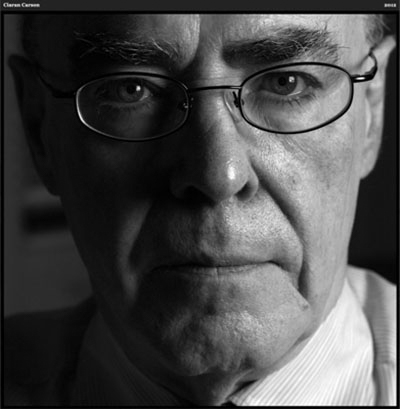
Jim Maginn has visited a lot of singers and musicians in his time, and so have I. Many of the people in this book are known to me, or were known to me, for the light of this world no longer shines on them. Going through these photographs is for me a journey back in time to the many pleasurable times I spent in the company of these musicians and singers in small back rooms, wherever I found them, by whatever happenstance I do not know. One thing led to another, as one tune in a session leads to another. Fond memories indeed. I have been privileged to have known a good many of these people, but I believe that a great photograph transcends such particular personal associations. A viewer need not know the subject to know that the photograph works, and is true to its subject. I have never met the McGoldricks, Eddie, Hugh and Mary, for instance; but Jim Maginn’s wonderful photograph of them gives me a sense almost of déjà vu. I feel this is a good place to be in. One wants to be in this room with these people and their dog. They are happy to be where they are, looking at the camera as they seem to look at us. This is what great portrait photography does: it makes us appreciate the lives of others, the lived-in grain of their faces, their stance, the way they hold themselves. We look at the photographs in this exhibition, this book, and our lives are enriched by the light of those other days.